

90% of All Sales Training Fails

Discover what successful programs do differently to produce long-term results.

Executive Summary

Most organizations invest in sales training yet few see long-term performance gains. In fact, our research shows that it has a 90% failure rate.

Let that sink in – a billion-dollar industry is providing a service with a 1-in-10 chance of producing a significant payback. Does this big investment in time and money still make sense in today’s increasingly digital world?

Ongoing learning is essential to staying competitive, but the road map looks different for every business and team. Experience alone isn’t enough, and generic, one-off training workshops don’t move the needle in the long run.

Three salespeople seated in a conference room

That’s why successful training programs focus on critical selling skills that can be taught, practiced, and measured regularly. They embed training into the daily rhythm of sales activity, and now, they’re using modern AI-driven tools to bridge the gap between knowing and doing.

This page explores why most programs fall short, what the most effective ones do differently, and how you can gain measurable, lasting improvement.

Woman taking notes while at a laptop

Where Sales Training Breaks Down

Almost everyone has experienced a great seminar. You laughed, took notes, and maybe even had a few immediate quick wins in the field. But a month later, the impact fades.

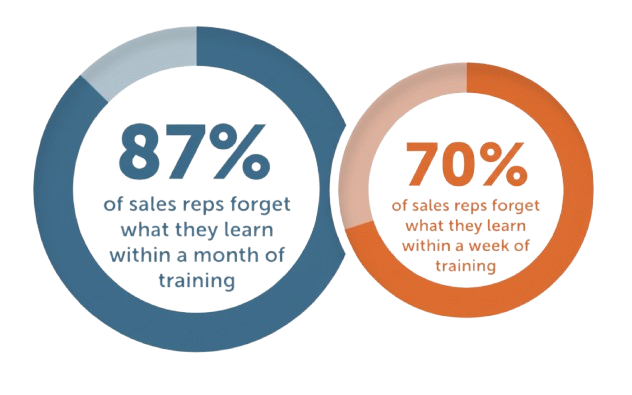
Gartner research shows that B2B sales reps forget 70% of what they learn within a week of training and 87% within a month. Without reinforcement, even the most compelling content won’t take hold.

While retention is part of the problem, it’s not the whole story. Forgetting alone doesn’t explain why so many programs fail to produce lasting performance improvements. In reality, sales training breaks down for three primary reasons:

Stats on what sales reps retain from training
1

Wrong Content

Too often, training focuses on traits like personality or motivation. They’re important factors but not teachable skills. The result is wasted effort on qualities that can’t be developed through training. The content must be built around a proven sales process that aligns with how your buyers make decisions.

2

Rejection by Salespeople

Some salespeople arrive convinced they already know it all. Others fail to see how the program addresses their challenges. Unless salespeople buy into the training and recognize it as a solution to their needs, learning won’t be absorbed. Just as in a sales call, you must first sell the value of the training itself.

3

Ineffective Transfer

Learning that never makes it into daily practice isn’t learning at all. Transfer requires more than follow-up reminders – it depends on active involvement during training, relevance to real-world situations, consistent reinforcement, and accountability from managers. When these elements are missing, the result is a short-term boost followed by a return to old habits.

In short, most sales training fails not because salespeople can’t learn but because the program doesn’t align with how people retain knowledge and change behavior.

The Practices That Set Successful Sales Training Apart

If most programs miss the mark, what do the successful few do differently? They solve each failure point with clear, repeatable practices that turn learning into behavior change.

Drive Engagement With Relevant Content

1

Document the Sales Process

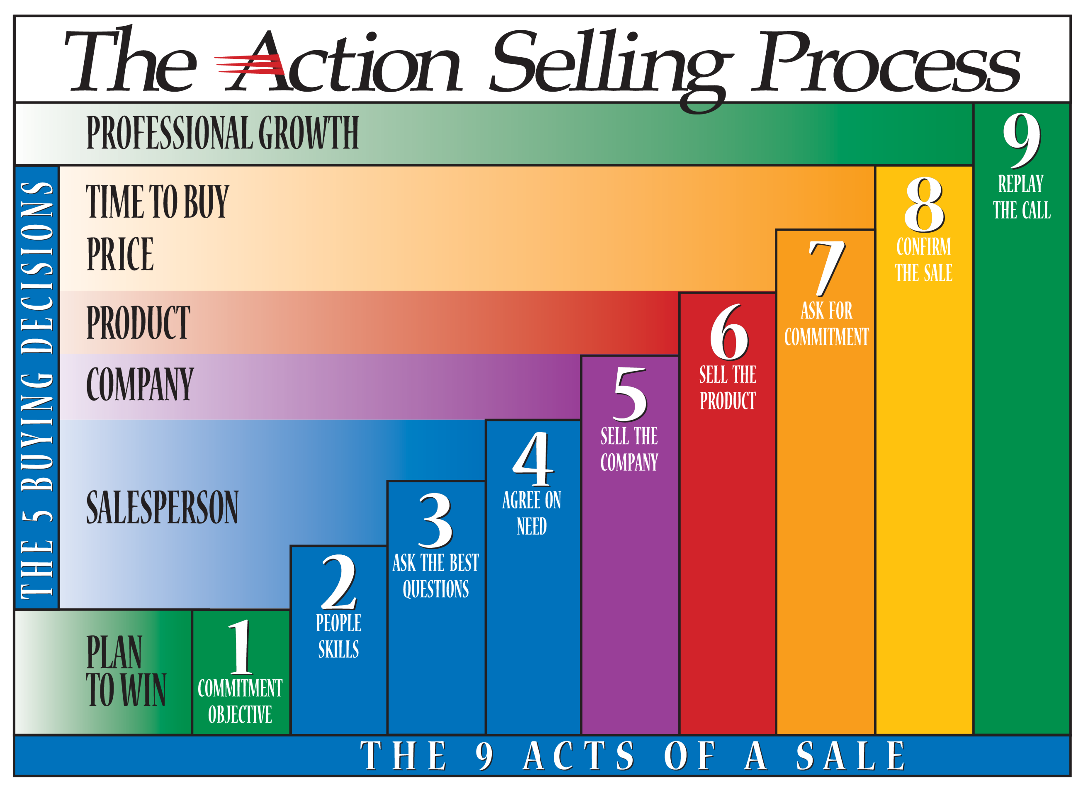
The most effective programs anchor training to a research-based sales process that mirrors how buyers make decisions. This gives reps a clear road map and managers a framework for coaching.
How?

Map your buyer’s decision path, define seller behaviors that advance each stage, and document the process in playbooks and training. A visual model helps make the process tangible.

The Action Selling Process
2

Sharpen Critical Selling Skills 

Effective programs don’t try to teach everything. They focus on the core skills that directly influence sales outcomes and can be taught, practiced, and measured:

People with arrows pointing to them icon

Building the buyer-seller relationship

According to a Salesforce report, 86% of business buyers are more likely to purchase if companies understand their goals – underscoring the importance of aligning the sales approach with the buyer’s decision-making process.

Phone and chat bubble icon

Planning sales calls

There should be a commitment objective for every call, meaning every rep should know what they want the customer to agree to do next. Poor planning is often a sign of an unclear sales process to follow.

Chat bubble and question mark icon

Asking effective questions 

Questions are the number-one tool in a salesperson’s toolkit. They uncover needs, highlight interest, and keep conversations moving forward.

Person pointing at sales chart icon

Delivering relevant presentations

Customers don’t want a long presentation on everything your product or service can do. These engagements should be short, targeted, and focused on their unique needs.

Handshake icon

Gaining commitment

Many reps have a hard time asking for some sort of commitment, but without it, deals rarely move forward.

How?

Benchmark reps against these skills, practice ways to strength the weakest areas, and connect each skill to live deal so training feels immediately relevant.

People sticking notes to a clear surface
3

Tailor Learning to Company Objectives

Generic training is quickly lost. Effective programs connect training to organizational goals so reps can see why it matters. 

How?

Identify the business objectives you want training to support, such as shorter sales cycles or higher win rates. Then map those goals to the specific skills reps need to strengthen. With clear priorities, you can build a training plan that ensures skill transfer and reinforcement, while aligning exercises to your sales environment and value proposition.

Gain Buy-In From Salespeople

1

Prep for Team and Management

Top programs ensure both reps and managers enter training ready to engage. Pre-work and baseline assessments highlight gaps and frame training as a solution. 

How?

Use skills benchmarks and self-surveys to identify development needs before training starts, and give primers and prep work so participants understand what to expect and how it connects to their role. Train managers first so they can model and coach effectively, then hold them accountable by measuring the quantity and quality of learning activities across their team.

Woman smiling as she shows sales results on a laptop
Two salespeople walking down a hallway
2

Get Aligned on the Need

Salespeople won’t buy into training they don’t see as relevant. Successful programs position it as the answer to challenges reps and managers already recognize and agree with. Learning should never feel forced.

How?

Share benchmark data, highlight common obstacles, and connect training goals to earning potential and pipeline health. When everyone is aligned on needs, sales teams are open to your training solution.

3

Involve Reps in Best Practices

Reps gain ownership when they help shape the playbook. Programs that identify top-performer practices and let the broader team refine them see stronger adoption and better results.


How?

Many high achievers can’t articulate the small decisions and behaviors that make them effective, yet those details are exactly what teams need to raise their game. Use structured exercises during training to capture the real tactics that drive success – such as the best discovery questions to uncover needs, the commitments to gain in calls, and the most effective ways to handle objections. Then share and reinforce those tactics through live practice.

Salespeople standing for a team meeting

Reinforce and Measure for Long-Term Impact

Two women smiling as they review sales data on a laptop
cirlce-1@2x-3

Coach With Accountability

Learning takes hold when managers coach to the process and model the skills themselves. If leaders are left out, the initiative is doomed to fail. Workload and experience don’t change the fact that managers must be held accountable for the learning and performance of their teams.

How?

Give managers the same training as their salespeople along with the tools they’d need to coach effectively in the field, such as instructor guides, call review forms, and activity reporting. Hold leaders to the same certification standards as reps, track progress across teams, and reinforce with meaningful incentives. Top-level executives should also play a role by participating in learning and reviewing outcomes. This level of involvement shows that developing sales capability is more than a task, it’s a priority.

cirlce-2@2x-2

Reinforce

Gartner research shows that effective coaching can increase sales performance by 8%. Coaching is also key to reinforcement, which is why the best programs blend instructor-led coaching with modern technology to ensure practice starts immediately after training and continues until skills become habits.

How?

Get teams practicing with micro-lessons, live roleplay labs, and field activities tied to specific skills. Be consistent  ongoing reinforcement is what turns new concepts into routine use. Intelligent solutions like AI-driven coaching can free up manager time and give reps a safe, judgment-free space to apply learning on demand and as often as needed by:

  • Mirroring the buyer's decision journey in realistic selling scenarios
  • Providing instant feedback on clarity, pacing, and relevance
  • Initiating real-world sales conversations based on specific ICPs

When combined with in-person training and leadership input, AI can be a valuable tool for helping sales teams master critical skills.

cirlce-3@2x-2

Measure

Attendance isn’t adoption. Successful organizations measure behavior change and certify skills over time – because in sales training, what gets measured gets learned.

How?

Reassess skills against the benchmark around 90 days after the workshop to explore progress. Each evaluation should factor both knowledge gain and the ability to apply that knowledge for a full understanding of retention and performance. Strengthen accountability by setting a certification standard that requires reps to demonstrate proficiency. Define clear goals that represent mastery, and award certification only when those standards are met.

Businesswoman seated and presenting to her team

Turn Training Into Tangible Results

You don’t have to be part of the 90% of sales training that fails. By focusing on the skills that matter most, reinforcing them through a proven process, and blending in-person coaching with AI-enabled practice, you can transform learning into measurable results. Equip your team so they know what to do at the moments that matter most.

Power Sales Performance for Every Rep

Connect with our sales experts to build a custom training program tailored to your needs.